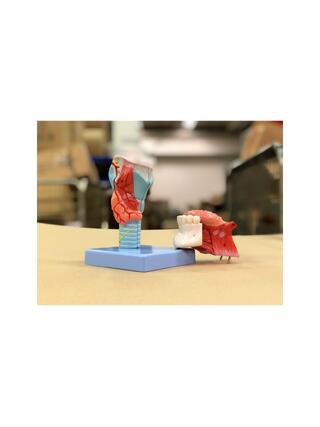
Enlarged strub model
This enlarged and pedagogical larynx model with vocal folds also shows several related tissues such as muscles, the thyroid gland and part of the trachea. The larynx weighs 800 grams and the height is 20 cm. It shows the tissues in twice normal…

- In stock – delivery 4-8 days
- Cheapest shipping from 8.85 €
- Pay with Swish, card or invoice
- Personal customer service by phone and e-mail
- Swedish online store since 2008
This enlarged and pedagogical larynx model with vocal folds also shows several related tissues such as muscles, the thyroid gland and part of the trachea.
The larynx weighs 800 grams and the height is 20 cm. It shows the tissues in twice normal size and can be divided into 5 parts (see the pictures on the left and read more about this below). It comes without a stand.
Virtually all anatomical structures on the model are numbered and were originally named in English. We have improved it so that the names are displayed in Latin and possibly. Danish of special structures such as "false" voice lip. You can download and print the overview via our website - see under the product images on the left.
Anatomically, the larynx model mainly shows the larynx (larynx) with the laryngeal cartilages (blue color), the laryngeal muscles (brown color) and the vascular and nerve supply of the larynx (in red and yellow, respectively). The model also shows the two closing mechanisms, which are the larynx (epiglottis) and the vocal folds (plicae vocales) as well as the two joints (articulatio cricothyroidea and cricoarytenoidea).
On the right side of the model, the thyroid gland is seen in orange (thyroid gland), which in front covers the lower part of the larynx and the upper part of the trachea. Trachea in blue forms the lower part of the model and is seen with the characteristic "horseshoe-shaped" cartilage rings. On the back of the thyroid gland are seen 2 of the parathyroid glands (usually there are four in humans).
Above the larynx, the tongue bone is seen in sand color (os hyoideum), muscles, etc. Even if the larynx is not delimited on the back of the model, you can still feel / imagine part of this vertical tube.
The model can be divided into 5 parts as follows:
From top to bottom (from the tongue bone to the bottom end of the model's trachea) the model can be divided "in the middle"
If the model is divided as mentioned above, the right part can also be divided into the lower edge of the thyroid gland
In addition, two muscles can be removed from the left side of the model (m. Thyrohyoideus and m. Cricothyroideus)
When it comes to movement, the larynx model is not flexible. You cannot show movements in the two joints.
Clinically, the model can be used to understand many diseases such as epiglottitis, vocal cord polyps, nodular goiter, edema of the larynx and cancer.
Furthermore, the neck model can be used to understand the survey method
| Item number | A440_ |