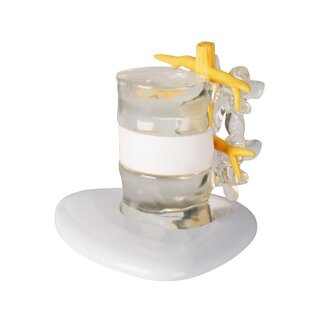

Model of herniated disc with nerves and three replaceable discs
Model of herniated disc with nerves and three replaceable discs.
- In stock – delivery 1-2 weeks
- Cheapest shipping from 11.20 €
- Pay with Swish, card or invoice
- Personal customer service by phone and e-mail
- Swedish online store since 2008
This model is a perfect tool when illustrating disc herniation. The model contains two spinal discs, the spinal nerve and three different discs; a new dish, one with a dorsolateral hernia and one with a central hernia. All three discs fit into the model and can be easily replaced.
The discs are made of a soft and flexible material, making them real in life. The model is delivered on a base measuring 18x18 cm. The vertebrae can be removed from the base.
Anatomically, the model shows 2 lumbar spines and thus the two main joint types in the spinal column, which are the symphysis (disci / intervertebral discs) between the vertebral bodies and the facet joints that are sliding between the vertebrae of the spine. Overall, the bone quality is good, and therefore larger protrusions in the bone tissue are seen. In addition, the spinal nerve is seen.
The model also contains 3 different discs. Between the lumbar spine, a disc is seen without anything abnormal. On the stand there are two abnormal discs that allow to demonstrate a median and a lateral disc herniation.
When it comes to movement, this model is not flexible. It cannot be moved at all and therefore cannot be used to show the spine.
However, the model can be separated and the two abnormal discs can be inserted between the lumbar vertebrae. In this way, the two different types of disc herniation and the consequences can be demonstrated.
Clinically, this model has been developed for the understanding of disc herniation. However, the model can also be used to understand other diseases such as spondylosis, spinal cord, osteoarthritis (arthrosis), spondylolisthesis (joint defects), fractures (fractures), etc.
| Item number | A208 |