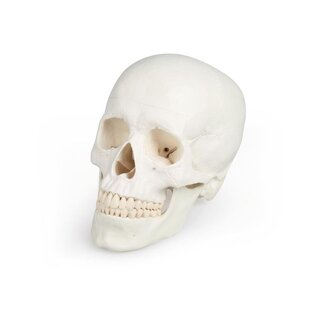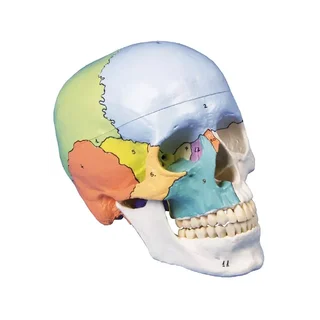


Adult-sized anatomical skull model II
Skull model cranium that covers most needs The skull model is cast in white plastic and comes in a size that corresponds to an adult with slightly Asian features due to strong cheekbones and a generally slightly rounder face shape.
- In stock – delivery 4-8 days
- Cheapest shipping from 11.20 €
- Pay with Swish, card or invoice
- Personal customer service by phone and e-mail
- Swedish online store since 2008
Skull model cranium that covers most needs
The skull model is cast in white plastic and comes in a size that corresponds to an adult with slightly Asian features due to strong cheekbones and a generally slightly rounder face shape.
The skull cap ("top") can be removed, so the skull base (basis cranii interna) can be studied. The skull cap is held in place by small magnets and plastic pins, which are only visible when removed. The model contains many smaller details, although not all details are visible.
The model is unpolished, which may mean minor irregularities and a slightly rough surface layer, etc. These are small flaws.
Anatomically
Anatomically, the human skull can be divided into 2 parts, and the skull model therefore shows the following:
1) The braincase (neurocranium), which is intended to enclose the brain and the auditory balance organ
2) The facial skeleton (viscerocranium) which surrounds the nasal cavity and forms the tooth-bearing framework around the oral cavity. The 32 teeth are also included
The braincase consists of 8 bones. There are 4 unpaired (frontal, sphenoid, sphenoid and occipital bones) and 2 paired (occipital and temporal bones). All of these bones as well as sutures can be identified on the skull model.
The facial skeleton includes 6 paired bones (maxilla, mandible, cheekbone, nasal bone, lacrimal bone, and inferior concha) and 3 unpaired bones called the mandible, zygomatic bone, and zygomatic bone (some do not count the zygomatic bone as part of the facial skeleton). All of these bones and sutures can also be identified on the skull model. NOTE: The hyoid bone is also part of the facial skeleton but cannot be seen on this skull model.
The human skull contains many holes and canals that contain vessels and nerves. Overall, there are connections between the brain and the neck, to and from the orbital cavity, to and from the pterygo-palatine fossa, and to and from the nasal cavity.
This skull model shows many of the most important holes and canals, but not all. In addition, the level of detail of the bones is good. When it comes to "osseous landmarks" such as the styloid process, many of the most important ones are seen, while some smaller details are omitted.
NOTE: If you are looking for a more detailed skull model, we recommend our extremely realistic skull model. On the skull model, the number of holes and channels and the level of detail in the bone structure are as anatomically complete as possible. It is purchased, among others, by medical students. See it HERE
Movement
In terms of movement, it is only relevant to mention the temporomandibular joint. The lower jaw bone ("jaw bone") is held in place via a relatively long metal spring, which is attached with screws to the jawbone and mandible. In addition, large rubber pieces are mounted in the mandibular joint sockets (fossa mandibularis), which hold the joint head (caput mandibulae) "as if in a rubber cup" (see the pictures on the left).
The model's jaw joints are not very flexible. Natural movements in the jaw joint require that, among other things, the joint head can slide forward and downward until the joint head is forward on the tuberculum articulare. The latter is the bony part with a weak guide groove in front of the depression (fossa mandibularis). This can only be demonstrated on the model if the rubber in the joint sockets is removed, which the model is not designed for.
However, if you take a firm grip on the lower jaw, you can move it up and down and to the sides, although the natural sliding joint mechanism described above cannot be demonstrated at all.
The lower jaw can be removed completely, but at least one screw must be removed with a screwdriver.
Clinically speaking
Clinically speaking, the skull model is ideal for understanding diseases, disorders and disorders in this part of the skeleton.
NOTE: This brain model is compatible with: https://www.swehealth.com/product?product_id=4329
< /p>
| Item number | 6041.50.00 |