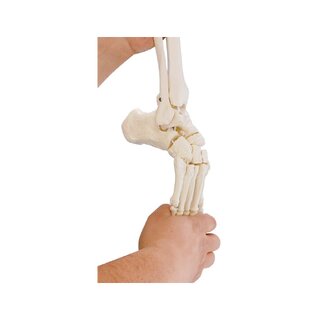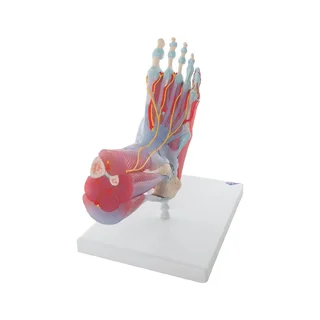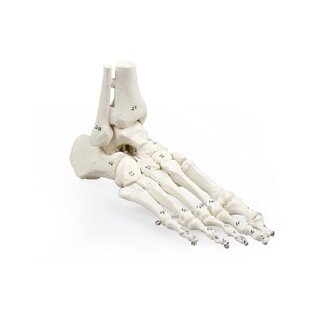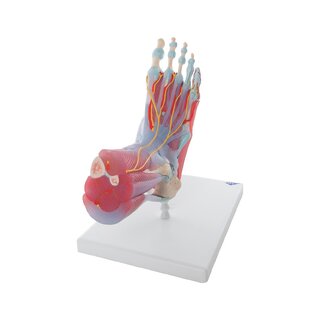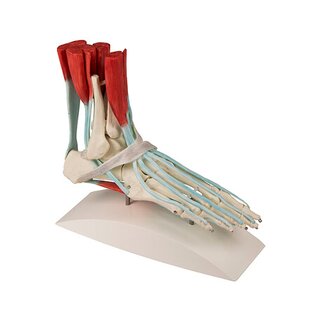


Functional model of the foot
The model was developed in collaboration with Dr. Urs Schneider, Mannheim. Suitable for interested students and aspiring orthopedists. Firstly, the displacement of the individual ankle bones during the transition from a normal position to …
Cheapest shipping from 11.16 €
 Part-pay from 150.40 €/mo
SKU:
NS 54/1
Stock Status:
In Stock
Delivery Status:
4-8 days
- In stock – delivery 4-8 days
- Cheapest shipping from 11.16 €
- Pay with Swish, card or invoice
- Personal customer service by phone and e-mail
- Swedish online store since 2008
The model has been developed in collaboration with Dr. Urs Schneider, Mannheim. Suitable for interested students and aspiring orthopaedists. Firstly, the displacement of the individual ankle bones during the transition from a normal position to inversion and eversion in an unstressed foot can be shown. The aim of this is to provide an insight into the movement patterns of the foot under physiological and pathoanatomical circumstances. To facilitate the understanding of these complex movements, the foot has been reduced to the ankle bones, where the movements themselves "occur", two of the most important inverting and everting muscles and the ligament systems required to control and limit movements. The effects of the different movements on the mechanics of the midfoot and forefoot will be investigated in the theoretical part of this study where quantification of leg movements is also discussed. By facilitating the understanding of the movements of the individual ankle bones, the model is also intended to provide an introduction to Kapandji's model of heterokinetic cardan joints (Kapandji 1992). This should promote an understanding of the statics and dynamics of the entire foot and the role it plays in lower limb movements. The second theoretical part of the study and gait analysis in particular should also contribute to this.
CONTACT US FOR DELIVERY TIME
| Item number | NS 54/1 |