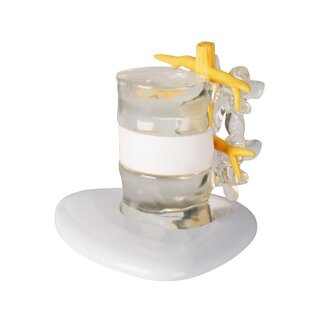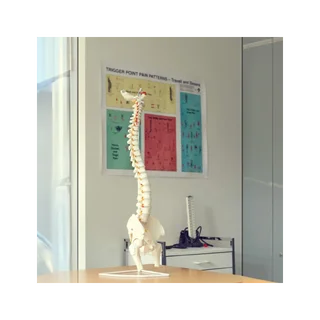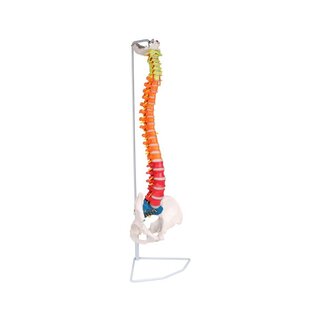


Flexible spine with extra soft discs and stands
This unique spine is specially designed to show the natural movements of the spine in a healthy person and in pathological conditions.
 Part-pay from 51.76 €/mo
- In stock – delivery 2-3 weeks
- Cheapest shipping from 11.15 €
- Pay with Swish, card or invoice
- Personal customer service by phone and e-mail
- Swedish online store since 2008
This unique spine is specially designed to show the natural movements of the spine in a healthy person and in pathological conditions.
Instead of a standard copper wire, the spine is mounted on a flexible spiral metal wire that creates almost unlimited movement while making the model extra durable.
In addition, all the dishes are made of special foam that moves like real dishes. The model therefore makes it possible to illustrate a number of conditions such as scoliosis, lordosis, kyphosis or subluxation. Herniated discs can also be demonstrated by compressing two vertebrae. The model contains the spinal cord and spinal nerves and comes with a nice stand.
Anatomically, the model shows the entire vertebral column, which consists of a neck, a thoracic section, a lumbar section, a pelvic section and the coccyx. The occipital bone is also included. The model therefore shows the two most important joint types in the spine, which are the symphysis (disci / discs) between the vertebral bodies and the facet joints that are sliding between the vertebrae of the spine. The lower neck and sacroiliac joints are also seen. Since the occipital bone is included in this model, the upper neck is also seen.In addition, the model shows the base as a whole as a ring structure. Therefore, the model also shows the SI joint between the sacrum and the coccyx and the symphysis between the coccyx bones. In addition, the model shows 31 pairs of spinal nerves. Overall, the bone quality is really good, and for example, nodules and indentations in the bone tissue are clearly visible.
In terms of movement, this model is flexible. The human spine is largest in the neck and lumbar region (which is lordotic), while the thoracic part (which is kyphotic) is less mobile. This model can be used to demonstrate the main movements of the spine, which are flexion-extension, lateral flexion and rotation of the neck and hips.
The above-mentioned flexible spiral tube creates good mobility and makes the entire spinal tube durable. In addition, the special "foam disc" can be expanded and compressed depending on the movement. In this way, they reproduce the dynamics of the human spine in the most natural way. On the other hand, these "foam discs" are glued between the vertebrae and therefore cannot be loosened.
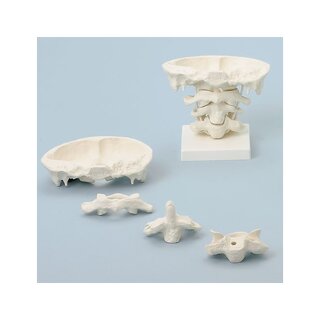
The cervical spine (os occipitalis), the upper cervical spine (atlas) and the second upper cervical spine (axis) are assembled with a zipper so that the main movements of the upper and lower cervical joints can be demonstrated. These movements are the nail and the rocking of the head, which take place in the upper body and the shaking of the head, which take place in the neck.
Clinically, this model is designed to demonstrate scoliosis. It can also be used to understand disorders such as herniated discs, root relations, spinal spondylosis, spinal stenosis and osteoarthritis (osteoarthritis).
Due to the special "foam disc" that is glued to the vertebrae, this model is not ideal for showing spondylolisthesis (damage to the joint). The model can of course also be used to understand fractures (fractures) and pelvic disorders
| Item number | 1008545 |