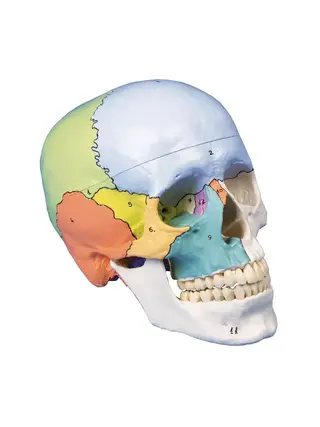
Mini skull model with removable skullcap, 3 parts
Detailed skull model that is so small it can fit in your hand, this is perfect.
- In stock – delivery 4-8 days
- Cheapest shipping from 8.85 €
- Pay with Swish, card or invoice
- Personal customer service by phone and e-mail
- Swedish online store since 2008
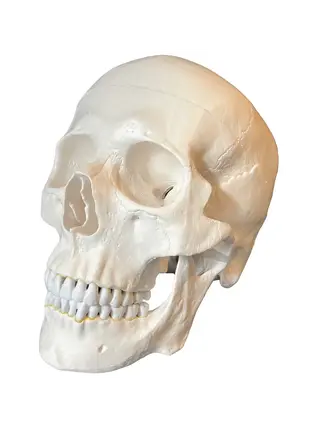
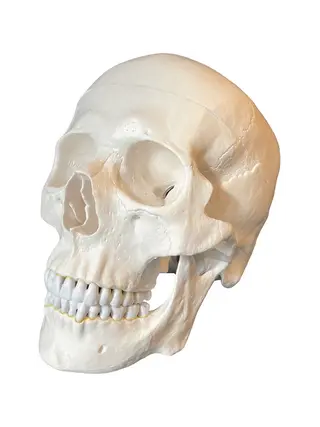
The model is cast in white plastic and the dimensions are 10 x 6.5 x 7.5 cm. The top of the skull is removable so that, among other things, the skull base (basis cranii interna) can be studied. The top of the skull is held in place with the help of small discreet magnets.
This skull model is identical to the skull on our detailed and only 85 cm high mini skeleton that is very popular with our customers. See the skeleton model HERE.
Anatomically, a human skull can be divided into two parts and the skull model therefore shows the following when the muscles are removed:
1) The braincase (neurocranium) which encloses the brain and the organ of hearing and balance.
2) The facial skeleton (viscerocranium) which surrounds the nasal cavity and forms the tooth-bearing framework around the oral cavity. The 32 teeth are also visible.
The braincase consists of eight bones – four unpaired (frontal, ethmoid, sphenoid and occipital bones) and two paired (parietal and temporal bones). All of these bones and their sutures can be identified on the model.
The facial skeleton consists of six paired bones (maxilla, palate, hyoid, nasal and lacrimal bones and the inferior nasal concha), as well as three unpaired bones (mandible, hyoid bone and pluvial bone – however, some do not count the hyoid bone as part of the facial skeleton). All of these bones and their sutures can also be seen on the skull model. NOTE: The hyoid bone is also included in the facial skeleton but cannot be seen on this model.
The human skull has quite a few holes and channels that contain blood vessels and nerves. Many of the most important holes and channels can be seen on this skull model, but not all. The most important anatomical "landmarks" are seen, such as the styloid process, but smaller details are not included.
In terms of movement, it is only relevant to mention the temporomandibular joint. The lower jaw bone (os mandibularis) is held in place by a relatively long metal spring that is attached to the lower and upper jaw bones via screws.
If you grasp the lower jaw, it can be moved, but the natural movements of the jaw cannot be demonstrated.
The lower jaw can be detached from the rest of the skull by unscrewing at least one of the screws with a screwdriver.
Clinically, the model is good to use for understanding diseases and conditions that can occur in this part of the skeleton, although most people probably use it for parties, decorations or the like.
| Item number | A105-1 |